
Insights & Resources
From Research Updates, Case Studies, Blogs, Product Primers, Video guides, Webinars, News, FAQs

XLRI - Xavier School of Management
Placement Operations at XLRI
XLRI implemented Skynet in October 2018 to automate its Day placement process — replacing manual scheduling and student tracking with a single integrated platform. When the pandemic forced a shift to remote operations, EDTEX delivered a full Virtual Placements module, enabling XLRI to conduct its Summer Internship Process entirely online without disruption.
Since its implementation, Skynet has significantly enhanced XLRI's placement processes, demonstrating exceptional performance and reliability across multiple placement seasons for students, the Placement Committee, Institute Administration, and participating companies.
A process built for a different era
XLRI's placement process involves coordinating hundreds of students, multiple recruiting companies, and a placement committee — simultaneously and under significant time pressure. Before Skynet, this coordination relied heavily on manual processes: spreadsheets, emails, and ad-hoc scheduling tools that created fragmentation and limited real-time visibility.
When COVID-19 arrived, the challenge escalated — the institution needed to replicate the full placement experience in a virtual environment, without compromising quality, timelines, or participant experience.
Where the process was failing
- Manual Day placement scheduling prone to conflicts and coordination errors
- No real-time student tracking during active placement drives
- Fragmented communication between students, placement committee, and recruiters
- No infrastructure for virtual placement delivery during the pandemic
- High administrative burden on the placement office across every placement season
How Skynet changed Day 0
EDTEX deployed Skynet at XLRI to automate the full Day placement process — including structured scheduling, real-time student tracking, and centralised coordination across all stakeholders. When the pandemic hit, EDTEX developed a dedicated Virtual Placements Automation module with purpose-built interfaces for both students and companies.
Day placement automation
Structured scheduling and real-time student tracking across the full Day placement cycle.
Virtual SIP delivery
XLRI's Summer Internship Process conducted 100% virtually using Skynet's virtual placements module.
Dedicated student & company interfaces
Purpose-built portals for each stakeholder group ensuring seamless participation in virtual placements.
Continuous EDTEX support
On-ground support during active placement seasons with prompt issue resolution across all cycles since 2018.
What XLRI achieved
- Full automation of Day placement scheduling and real-time student tracking
- Virtual SIP conducted end-to-end with zero disruption during COVID-19
- Dedicated student and company interfaces for virtual placements
- Unanimous satisfaction across students, administration, committee, and recruiters
- Consistent, reliable operation across 6+ placement seasons since 2018

OP Jindal Global University
Course bidding at OPJGU
In 2020, OP Jindal Global University partnered with EDTEX to deploy Registro CBS — digitising its entire elective course bidding process through time-based selection windows. For the first time, more than 5,000 students could participate in a single registration window across 10+ schools and 45+ programmes, simultaneously and without administrative bottlenecks.
This innovation reduced manual effort by more than 97% for both Programme Offices and students, and allowed the institution to implement programme-specific credit policies, support multi-term bidding involving multiple elective rounds, and reduce overall student queries by 99% during course registration. To date, Registro has supported over 30,000 students and 5,000 electives cumulatively since its first implementation.
Bidding at impossible scale
Course bidding at OPJGU is one of the most complex academic operations in India's higher education landscape. The institution runs multi-term bidding across 10+ schools, each with its own credit policies, seat-sharing rules, and specialisation or concentration requirements.
Before Registro, this process required significant manual coordination between IT offices and programme teams — leaving room for error, policy inconsistency, and a high volume of student queries during every registration cycle. The existing approach could not scale with OPJGU's growing student intake.
What the manual process couldn't handle
- No unified system for multi-school, multi-term elective bidding
- Manual coordination between IT office and programme offices causing delays and errors
- Inability to implement and enforce programme-specific credit policies at scale
- High volume of student queries during every registration cycle
- No student visibility into course allocation process or seat availability
- Scaling limitations as student intake grew across schools and programmes
How Registro CBS took over
EDTEX deployed Registro CBS configured to handle OPJGU's full operational complexity — programme-specific credit policies, multi-term bidding rounds, seat sharing across schools, and concentration or specialisation implementation — within a single unified platform. EDTEX worked closely with the IT Office and Programme Offices to design the process, establish best practices, and customise the bidding system.
Time-based registration windows
5,000+ students managed simultaneously in a single real-time bidding window.
Programme-specific credit policies
Automated enforcement of individual programme credit rules and concentration requirements.
Multi-term bidding support
Multiple elective bidding rounds across terms — all managed within one platform.
Seat sharing & specialisation
Complex seat-sharing logic across schools with concentration and specialisation implementation.
Full student visibility
Students have complete visibility into the course allocation process — eliminating uncertainty and query overload.
End-to-end onboarding support
Power guides, live workshops, live chat support, and data preparation assistance for every bidding cycle.
The numbers that followed
- 97% reduction in manual effort for both programme offices and students
- 99% reduction in student queries during course registration
- 5,000+ students managed in a single real-time bidding window
- 30,000+ students and 5,000 electives supported cumulatively since 2020
- Programme-specific credit policies automated and enforced at scale
- Student satisfaction consistently rated above 4.5 out of 5.0
- First multi-term elective bidding cycles successfully delivered in India
Indian School of Business
Placement Operations Automation at ISB
In 2023, ISB Hyderabad & Mohali replaced its legacy placements platform with a fully customised deployment of Skynet — purpose-built to match the institution's unique placement workflows. The result is a unified, automated system serving students, the placement office, and recruiters across both campuses from a single dedicated cloud environment.
Recognising the unique needs of ISB's placement process, the Skynet platform was customised to fit the specific requirements of the institute — automating everything from student profile creation and CV generation to dream offer workflows, interview scheduling, and 50+ custom analytics dashboards.
A legacy system holding them back
ISB's placement process is not a standard workflow. It involves nuanced requirements — from dream offer management and PPT event tracking to custom access controls for different functional roles — that generic enterprise software cannot accommodate.
The existing legacy platform had become a bottleneck: unable to scale with the institution's needs, lacking the automation depth required, and demanding significant manual intervention at every stage. ISB needed a platform built around its process — not the other way around.
Where the old platform fell short
- Legacy platform unable to support ISB's depth of placement workflows
- Manual processes for CV generation, shortlisting, and offer management
- No centralised system for dream offer workflows and recruiter management
- Limited analytics and reporting capability for the placement office
- No cross-campus coordination between Hyderabad and Mohali on one platform
- High administrative overhead for invoicing, query management, and access control
A Skynet built for ISB
EDTEX deployed a fully customised instance of Skynet at ISB — designed in close collaboration with the placement office. The platform automates 16+ placement workflows across the full recruitment lifecycle:
- Student master profile creation, data validation & e-profile book
- Automatic CV generation in ISB's institutional format
- PPT event management with notifications & attendance tracking
- Applications and shortlisting management
- Dream offer workflows and offer management
- Interview scheduling across student and recruiter calendars
- 50+ custom reports and analytics dashboards
- Custom user access and functional control management
- Dedicated single-tenant EDTEX cloud for optimal performance
- Recruiter registration portal and invoicing workflows
- Query management system for placement season support
What the new platform delivered
- Legacy platform successfully replaced with zero process disruption at ISB
- Full end-to-end placement workflow automated across both Hyderabad and Mohali campuses
- 50+ custom dashboards delivering actionable placement analytics
- Dream offer workflows and recruiter portal live from day one
- Significant reduction in manual workload for placement office staff
- Improved transparency and real-time visibility for students and recruiters
Exceptional Support
Throughout the implementation and operational phases, the EDTEX team provided exceptional support to ISB Hyderabad. Their expertise in developing tailored software solutions ensured that the Skynet platform was perfectly aligned with the institute's specific needs. The team's responsiveness and commitment to addressing any issues promptly played a crucial role in the successful deployment of the system.
Conclusion
The implementation of the Skynet Placement Process Automation system at ISB Hyderabad represents a significant advancement in the institute's placement activities. By customizing the platform to meet their unique requirements, ISB Hyderabad has enhanced the efficiency, accuracy, and transparency of their placement process. The collaboration with EDTEX has proven to be highly beneficial, providing a robust and user-friendly solution that meets the high standards of the institution.
This tailored automation system not only streamlines the placement process but also ensures a seamless experience for all stakeholders involved, positioning ISB Hyderabad as a leader in innovative educational solutions.

National Law School of India University
Elective Course Bidding at NLS
NLS Bangalore, India's top law school, implemented an advanced Elective Course Bidding System developed by EDTEX — automating elective selection across undergraduate and graduate programmes on a single unified platform, significantly enhancing flexibility, efficiency, and transparency for students and administrators alike.
The new system allows students from various programmes — including the integrated BA LLB (Hons.), LLM, and other graduate degrees — to select their preferred elective courses through a unified platform. Students can tailor their academic journeys to align with their interests and career aspirations, regardless of their programme level.
Multi-programme complexity, one manual process
NLS Bangalore runs elective course selection across multiple undergraduate and graduate programmes — each with its own credit requirements, seat limits, prerequisites, and instructor constraints. Managing this complexity manually across programme offices created significant coordination overhead, limited student choice, and introduced inconsistencies in how electives were allocated across cohorts.
The institution needed a unified system capable of handling multi-programme elective selection at scale — fairly, transparently, and without placing undue burden on faculty or administrative staff.
Where students and admins lost time
- No unified platform for elective selection across undergraduate and graduate programmes
- Manual allocation processes prone to conflicts and inequitable seat distribution
- Limited student visibility into course availability, seat status, and bidding outcomes
- High administrative workload for faculty and programme staff during every registration cycle
- No mechanism for cross-programme elective access — restricting interdisciplinary learning
- Students unable to make informed decisions without centralised course information
How Registro CBS unified it
EDTEX implemented Registro CBS at NLS Bangalore — a purpose-built elective course bidding platform configured to handle the institution's full operational complexity across all programmes on a single system.
Integrated multi-programme management
Supports BA LLB (Hons.), LLM, and all graduate degrees — every student on the same streamlined process.
Cross-programme elective access
Students bid for electives across programmes, enabling interdisciplinary learning across law, business, policy, and international relations.
Fair allocation mechanism
Transparent engine minimises conflicts and maximises satisfaction by weighing student preferences against course availability.
Real-time updates
Live bidding status, seat availability, and allocation updates — enabling dynamic, informed decision-making.
Optimised resource utilisation
Efficient enrolment management ensures elective courses are filled effectively across all programmes.
The EDTEX team worked closely with NLS Bangalore throughout implementation — tailoring the system to institutional requirements, providing continuous support, and ensuring a smooth transition from the previous manual process.
What the platform delivered
- Advanced Elective Course Bidding System live across all undergraduate and graduate programmes
- Unified platform supporting BA LLB (Hons.), LLM, and multiple graduate degrees
- Cross-programme elective access enabling interdisciplinary learning
- Real-time bidding updates and seat allocation transparency for all students
- Significant reduction in administrative workload for faculty and programme staff
- NLS Bangalore positioned as a leader in innovative, student-centred academic operations
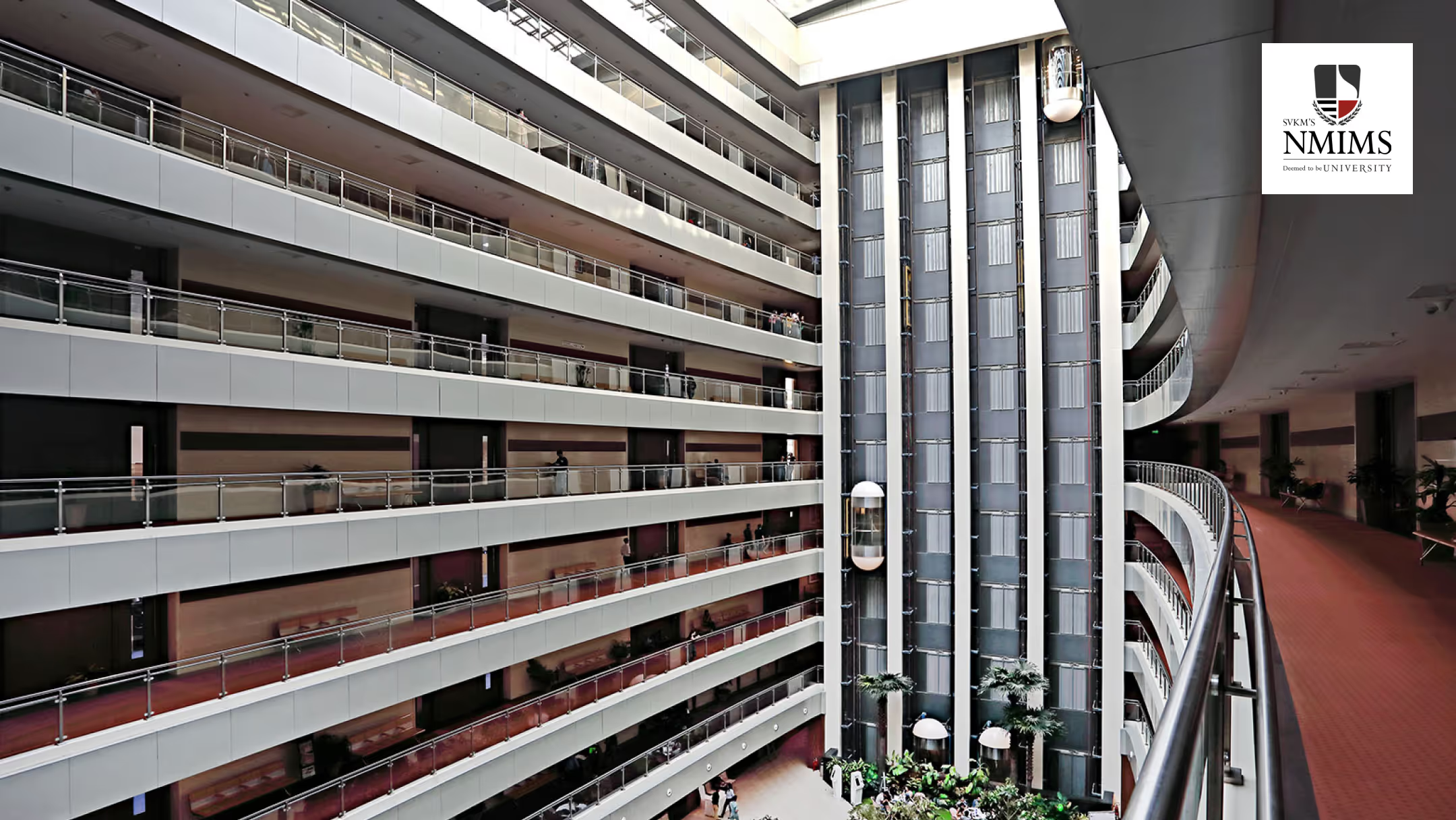
NMIMS Mumbai
MBA elective bidding at NMIMS
NMIMS Mumbai partnered with EDTEX in 2019 to digitise its MBA programme course bidding process using the Registro platform — replacing a manual, fragmented system with real-time, policy-automated elective selection. The implementation reduced manual effort by over 95% and student queries by 99%, while delivering clash-free timetables, multi-term bidding support, and concentration-based elective selection.
To date, Registro has supported 5 multi-term elective bidding cycles at NMIMS Mumbai, involving over 2,500 students and 500 electives cumulatively — with student satisfaction consistently rated above 4.5 out of 5.0. The implementation has also markedly enhanced overall resource utilisation, allowing for better planning to accommodate increasing student intake.
Multi-trim complexity with no automation
Course bidding at NMIMS Mumbai is a complex operation involving hundreds of MBA students across multiple trimesters, each with their own credit policies, concentration requirements, and timetable constraints. The institution also needed to manage workshop registrations and timetable scheduling alongside the bidding process — making the coordination challenge significant.
Before Registro, this process required extensive manual effort from the MBA Programme Office — from demand surveys and clash matrix generation to waitlist management and policy enforcement — with no unified system to handle the full lifecycle of elective selection.
What the manual process couldn't handle
- No unified platform for multi-term, multi-round elective bidding across MBA programmes
- Manual demand surveys and course clash matrix generation causing delays
- Timetable conflicts not detected at the time of course bidding
- No automated waitlist movement for students in waitlist queues
- Inability to enforce MBA concentration-based elective selection rules
- High volume of student queries during every registration cycle
- Manual coordination between MBA offices and students across Add/Drop rounds
How Registro CBS transformed it
EDTEX deployed Registro CBS at NMIMS Mumbai — configured in close collaboration with the MBA Programme Offices to implement best practices for elective course bidding. The platform was tailored to handle the full complexity of NMIMS's multi-term, concentration-based MBA elective selection process.
Elective demand survey & clash matrix
Automated identification of high-demand electives and generation of course clash matrix data ahead of each bidding cycle.
Clash-free timetable generation
Clash-free timetables generated and implemented at the point of course bidding — conflicts detected and resolved before allocation.
Multi-trim bidding & Add/Drop rounds
Full support for multi-trimester bidding cycles involving multiple elective bidding rounds and Add/Drop rounds.
Automatic waitlist movement
Students on elective waitlists are automatically moved into available seats without manual intervention.
MBA concentration-based selection
Registro tailored to support concentration and specialisation-based elective selection rules for MBA programmes.
Programme-specific credit policies
Automated enforcement of MBA programme credit requirements across all bidding rounds and trimesters.
EDTEX provided end-to-end onboarding support for both students and MBA Programme Office staff — including power guides in video and document formats, live workshops, policy consultation, live chat support during active bidding windows, and data preparation assistance.
Results across 5 bidding cycles
- 95% reduction in manual effort for both MBA programme offices and students
- 99% reduction in student queries during course registration
- 5 multi-term elective bidding cycles successfully delivered since 2019
- 2,500+ students and 500 electives managed cumulatively on the platform
- Clash-free timetables generated and integrated with the bidding process
- Automatic waitlist movement eliminating manual queue management
- MBA concentration-based elective selection enforced at scale
- Student satisfaction consistently rated above 4.5 out of 5.0
- Enhanced resource utilisation enabling better planning for growing student intake

IIM Udaipur
Elective bidding at IIM Udaipur
IIM Udaipur — ranked among the FT Top 100 Master of Management schools — digitised its MBA and MBA Analytics course bidding processes using Registro in 2020 and 2021. The implementation reduced manual effort by over 95%, student queries by 99%, and has since supported 5 multi-term bidding cycles across 1,200+ students and 700 electives.
The primary objectives were to streamline elective course selection for MBA students, ensure fair and transparent course allocation, enhance student satisfaction by aligning offerings with preferences, and reduce the administrative workload associated with manual course allocation. All four objectives were achieved following the Registro deployment.
The platform has markedly enhanced overall resource utilisation at IIM Udaipur, allowing for better planning to accommodate growing student intake — with student satisfaction consistently rated above 4.5 out of 5.0 across all bidding cycles.
Fair allocation with no fair system
Course bidding at IIM Udaipur involves hundreds of students from multiple MBA programmes — each with their own credit policies, timetable constraints, and concentration or specialisation requirements. Managing this complexity manually across programme offices created significant coordination overhead and left the institution without a scalable, fair mechanism for course allocation.
Following successful pilot testing of the Registro platform, the system was rolled out to the full MBA programme — with training sessions conducted for both students and faculty to ensure effective adoption.
What broke every registration cycle
- No unified platform for multi-programme, multi-round elective bidding
- Manual demand surveys and course clash matrix generation causing delays
- Timetable conflicts not detected or resolved at the point of course selection
- No mechanism to enforce MBA programme-specific credit policies automatically
- High volume of student queries during every registration cycle
- Inequitable access to electives due to absence of a fair allocation mechanism
- Significant administrative burden on programme office staff across each bidding round
How Registro made bidding work
EDTEX deployed Registro CBS at IIM Udaipur — configured in close collaboration with the MBA Programme Offices to implement best practices for elective course bidding across both the MBA and MBA Analytics programmes.
Elective demand survey & clash matrix
Automated identification of high-demand electives and generation of course clash matrix data ahead of each bidding cycle.
Timetable clash implementation
Timetable conflicts detected and implemented at the point of course bidding — preventing clashes before allocation is finalised.
Multi-round bidding support
Full support for multiple elective bidding rounds across terms — managing the complete selection lifecycle on one platform.
Fair allocation mechanism
Transparent algorithm considering bid points and course capacity — ensuring equitable access to electives for all students.
Real-time bidding status
Live updates on bid status, course availability, and seat allocations — enabling students to adjust selections dynamically.
Data analytics & reporting
Detailed reports on bidding patterns and course demand — enabling administrators to plan future course offerings with confidence.
EDTEX provided end-to-end onboarding support for both students and programme office staff — including power guides in video and document formats, live workshops, policy consultation, live chat support during active bidding windows, and data preparation assistance at every stage.
Results across 5 multi-term cycles
- 95% reduction in manual effort for both MBA programme offices and students
- 99% reduction in student queries during course registration
- 5 multi-term elective bidding cycles successfully delivered since 2020
- 1,200+ students and 700 electives managed cumulatively on the platform
- Timetable clash detection integrated directly into the bidding process
- MBA programme-specific credit policies automatically enforced across all rounds
- Fair allocation mechanism ensuring equitable elective access for all students
- Student satisfaction consistently rated above 4.5 out of 5.0
- Enhanced resource utilisation enabling better planning for growing student intake

IIT Bombay
Day 0 at IIT Bombay
IIT Bombay deployed Skynet Scheduler to orchestrate Day 0 of its placement season — managing 900 students, 40 companies, and 200 volunteers in real time with zero interview clashes. What was once a logistical nightmare became a seamless, automated operation.
Day 0 is one of the most high-stakes operational challenges in campus recruitment — hundreds of students being interviewed simultaneously by dozens of companies, with shortlists ranging from 40 to 500 candidates per company. Skynet Scheduler transformed how IIT Bombay manages this event, delivering clash-free schedules, real-time interview state tracking, and optimised volunteer deployment on a single platform.
900 students, 40 companies, one chaotic day
Coordinating Day 0 manually had always been a monumental task for the placement cell. With up to 40 companies holding interviews for shortlists of 40 to 500 students — and approximately 900 students to be interviewed in a single day — the risk of clashes and missed opportunities was significant. Beyond scheduling, 200 volunteers also needed to be deployed and managed simultaneously without a unified system.
What the placement cell was fighting
- Manual scheduling across 40 companies and 900 students leading to interview clashes
- No automated mechanism to factor in student preferences and shortlist load
- 200 volunteers deployed without optimisation — gaps in coverage and student confusion
- No real-time visibility into interview states or student progress during the day
- Last-minute schedule changes unmanageable without a dynamic adjustment system
How Skynet Scheduler took control
Automated clash-free scheduling
Advanced matching algorithms generate schedules with no overlaps — factoring in student preferences and per-company shortlist load.
Dynamic schedule management
Real-time controls at company and panel level — enabling live adjustments throughout Day 0.
Real-time interview state tracking
Live status updates on students and interviews across all companies throughout the placement day.
Volunteer coordination
Integrated deployment optimisation across all interview stations — reducing wait times and confusion.
Day 0 after Skynet
- 900 students interviewed on Day 0 with zero schedule clashes
- 40 companies managed simultaneously — shortlists of 40–500 handled without conflict
- 200 volunteers optimally deployed via integrated management
- Real-time interview state tracking across the full placement operation
- Dynamic adjustments at company and panel level throughout the day
- Overwhelmingly positive feedback from students and recruiters

IIM Sambalpur
Academic Ops at IIM Sambalpur
IIM Sambalpur partnered with EDTEX in 2023 to digitise its academic operations using the Registro Student Information System — a unified platform covering course bidding, timetabling automation, academic grading, and course feedback. This case study focuses on the Course Bidding Process implementation, which reduced manual effort by 95% and student queries by 99% from day one.
Registro SIS has markedly enhanced overall resource utilisation at IIM Sambalpur — enabling better planning to accommodate increasing student intake. To date, the platform has supported multi-term elective bidding cycles involving over 600 students and 200 electives cumulatively, with student satisfaction consistently rated above 4.5 out of 5.0.
Manual processes holding back growth
Course bidding at IIM Sambalpur is a complex operation involving hundreds of MBA students across multiple terms — each with their own credit requirements, specialisation pathways, and scheduling constraints. Before Registro, the PGP office managed this process manually: coordinating demand surveys, generating clash matrices, enforcing credit policies, and handling student queries entirely without automation.
As student intake grew, this approach became increasingly unsustainable. The institution needed a platform that could enforce programme-specific policies, support multi-term bidding, and give students full visibility into the allocation process — without placing additional burden on the programme office.
Where the friction was building
- No unified platform for multi-term, multi-round MBA elective bidding
- Manual demand surveys and course clash matrix generation ahead of each cycle
- Inability to automatically enforce MBA programme-specific credit policies
- No mechanism for seat sharing or concentration-based elective selection
- High volume of student queries during every registration cycle
- Limited student visibility into course availability and allocation outcomes
- Scaling constraints as student intake continued to grow
How Registro CBS fixed it
EDTEX deployed Registro CBS at IIM Sambalpur — configured in close collaboration with the MBA/PGP Programme Offices to establish best practices for elective course bidding. The system was customised to handle IIM Sambalpur's specific operational requirements across multi-term cycles.
Elective demand survey & clash matrix
Automated identification of high-demand electives and generation of course clash matrix data ahead of each bidding cycle.
Programme-specific credit policies
MBA programme credit requirements automatically enforced across all bidding rounds and terms — no manual intervention needed.
Multi-term bidding support
Full support for multi-term elective bidding cycles involving multiple rounds — all managed within one platform.
Seat sharing & concentration selection
Platform configured to handle seat sharing and MBA elective concentration or specialisation implementation.
End-to-end onboarding support
Power guides, live workshops, policy consultation, live chat during active bidding, and data preparation assistance at every stage.
Full student visibility
Students have complete transparency into the course allocation process — eliminating uncertainty and the query overload it generates.
What's changed since 2023
- 95% reduction in manual effort for both PGP offices and students
- 99% reduction in student queries during course registration
- Multi-term elective bidding cycles successfully delivered since 2023
- 600+ students and 200 electives managed cumulatively on the platform
- Programme-specific credit policies automatically enforced across all rounds
- Seat sharing and MBA concentration-based selection implemented at scale
- Student satisfaction consistently rated above 4.5 out of 5.0
- Enhanced resource utilisation enabling better planning for growing intake

IIM Rohtak
Elective bidding at IIM Rohtak
IIM Rohtak adopted Registro CBS in 2018 — making it one of the earliest IIMs to digitise its elective course bidding process. Since then, the platform has delivered 15 complete bidding cycles across 1,000+ students and 600 electives, with each cycle now executable in under 60 minutes. Manual effort is down 95%, student queries down 99%, and satisfaction consistently above 4.5/5.
The Registro platform has markedly enhanced overall resource utilisation at IIM Rohtak — enabling better planning as student intake has grown. The software efficiently manages a high volume of bids, ensuring a fair and smooth process that meets the diverse needs of the PGP student body across every bidding season.
A process that couldn't keep pace
Course bidding at IIM Rohtak involves hundreds of PGP students selecting electives under time pressure — with credit policies, seat limits, and programme requirements all needing to be enforced simultaneously. Before Registro, this was managed manually by the programme office: a slow, error-prone process that created bottlenecks, generated high volumes of student queries, and offered no transparent allocation mechanism.
As student intake grew, the limitations of the manual approach became impossible to ignore. The institution needed a system that could run complete bidding cycles quickly, fairly, and without overwhelming the programme office team.
What slowed every cycle down
- No unified platform for real-time elective bidding — cycles took days to complete manually
- Manual course allocation with no fair, transparent mechanism for students
- High volume of student queries during every registration cycle
- No automated enforcement of PGP programme-specific credit policies
- Limited student visibility into course availability and allocation outcomes
- Significant administrative burden on the programme office across each bidding round
How Registro made 60 minutes possible
EDTEX deployed Registro CBS at IIM Rohtak — configured in close collaboration with the PGP Programme Office to handle the institution's specific elective bidding requirements. The platform's real-time processing capability is what enables complete bidding cycles to be executed within 60 minutes.
Real-time bidding execution
Complete elective bidding cycles executed end-to-end in under 60 minutes — processing hundreds of student bids simultaneously in real time.
Automated fair allocation
Transparent allocation mechanism ensuring equitable elective access for all PGP students — eliminating manual intervention at the allocation stage.
Programme-specific credit enforcement
PGP credit requirements automatically enforced across all bidding rounds — no manual policy checking needed.
Full student visibility
Students have complete transparency into the allocation process — reducing uncertainty and eliminating the query overload it generates.
End-to-end onboarding support
Power guides, live workshops, policy consultation, live chat during active bidding, and data preparation assistance every cycle.
Scalable across growing intake
Platform scales seamlessly as student numbers grow — maintaining the same 60-minute cycle time regardless of volume.
7 years of results
- Complete elective bidding cycles delivered in under 60 minutes since 2018
- 95% reduction in manual effort for the PGP programme office and students
- 99% reduction in student queries during course registration
- 15 elective bidding cycles successfully delivered over 7 years
- 1,000+ students and 600 electives managed cumulatively on the platform
- PGP credit policies automatically enforced across all rounds
- Student satisfaction consistently rated above 4.5 out of 5.0
- Enhanced resource utilisation enabling better planning for growing student intake

IIM Trichy
Placements at IIM Trichy
IIM Trichy implemented Skynet in 2023 — a fully customised placement automation platform developed by EDTEX to fit the institute's specific workflows. The deployment automates 12+ placement processes end-to-end, from student profile creation and CV generation through to PPT event management, shortlisting, dream offer workflows, and custom analytics — all within a dedicated single-tenant cloud environment.
Recognising the unique needs of IIM Trichy's placement process, the Skynet platform was configured in close collaboration with the placement office — ensuring every workflow reflected the institution's specific operational requirements and high standards. The result is a seamless experience for students, recruiters, and the placement team across every placement season.
A process that needed a purpose-built platform
IIM Trichy's placement process spans a complex sequence of events — from pre-placement talks and profile shortlisting through to interview coordination and offer management — each involving multiple stakeholders and requiring precise coordination under significant time pressure.
Without a unified platform, this coordination relied on manual processes across disconnected tools — limiting the placement office's ability to track candidate progress in real time, manage recruiter relationships efficiently, and generate the analytics needed to evaluate and improve placement outcomes season after season.
Where the gaps were showing
- No centralised platform for managing student profiles, applications, and shortlisting
- Manual CV generation — time-consuming and inconsistent across student profiles
- PPT event management handled without automated notifications or QR-based attendance tracking
- No dream offer workflow — offer management done manually without structured escalation
- Limited recruiter management tools — job postings, profile access, and schedules uncoordinated
- No placement dashboard or custom reporting capability for the placement office
- Custom access controls absent — all users operating on the same permission level
A Skynet built around IIM Trichy
EDTEX deployed a fully customised instance of Skynet at IIM Trichy — designed around the institution's specific placement workflows and configured to automate every stage of the recruitment lifecycle.
Student profile & CV automation
Master profile creation, data validation, and automatic CV generation in IIM Trichy's institutional format.
PPT event management
Pre-placement talk scheduling with automated notifications and QR code-based attendance tracking for each session.
Applications & shortlisting
Centralised application tracking with real-time status updates for students — and efficient shortlist management for the placement office.
Dream offer workflows
Structured offer management including dream offer workflows — fully automated and tracked within the platform.
Recruiter registration portal
Customisable recruiter portal for job postings, student profile access, and recruitment schedule management.
Placement dashboards & custom reports
Powerful analytics and reporting tools enabling detailed performance tracking and data-driven placement strategy.
Custom user access control
Role-based functional access management ensuring data security across all user groups.
Dedicated single-tenant cloud
Exclusive EDTEX cloud environment delivering optimal performance and data isolation for IIM Trichy.
Throughout implementation and ongoing operations, the EDTEX team provided dedicated support — ensuring the platform was perfectly aligned with IIM Trichy's needs and addressing any issues promptly across every placement season.
What the platform delivered
- Full end-to-end placement lifecycle automated across 12+ workflows since 2023
- Student profile creation, validation, and CV generation fully automated
- PPT event management with automated notifications and QR attendance tracking live
- Dream offer workflows and offer management running without manual intervention
- Customisable recruiter portal serving all participating companies
- Placement dashboards and custom reports delivering actionable seasonal insights
- Role-based access control ensuring data security across all stakeholder groups
- Dedicated single-tenant cloud maintaining optimal performance throughout placement season

IIM Raipur
Elective bidding at IIM Raipur
IIM Raipur adopted Registro CBS in 2024 to digitise its MBA/PGP elective course bidding process — introducing multi-term bidding, clash-free timetable generation, and automated credit policy enforcement from day one. Manual effort dropped by 95%, student queries by 99%, and 300+ students have since been managed across multi-term cycles with satisfaction consistently above 4.5/5.
A standout feature of the IIM Raipur implementation is the integration of clash-free timetable generation directly into the bidding process — expanding the scope of available elective offerings for students while eliminating scheduling conflicts before they arise. The platform has also markedly enhanced resource utilisation at the institute, enabling better planning as student intake continues to grow.
Multi-term complexity with no infrastructure
Course bidding at IIM Raipur involves MBA/PGP students selecting electives across multiple terms — each with their own credit requirements, Add/Drop rounds, and programme-specific policies. Managing this complexity manually across the PGP office created significant coordination overhead, introduced timetable conflicts that went undetected until after allocation, and generated a high volume of student queries every registration cycle.
The institution needed a unified platform that could enforce credit policies automatically, generate clash-free timetables before bidding opens, support multi-term and multi-round bidding, and give students full visibility into the allocation process — all without increasing the burden on the programme office.
Where every cycle broke down
- No unified platform for multi-term, multi-programme MBA/PGP elective bidding
- Manual demand surveys and course clash matrix generation ahead of each cycle
- Timetable conflicts not detected before allocation — discovered only after registration closed
- Limited scope of available elective offerings due to unresolved scheduling constraints
- No automated enforcement of MBA/PGP programme-specific credit policies
- Add/Drop rounds managed manually — time-consuming and error-prone
- High volume of student queries every registration cycle
How Registro CBS solved it
EDTEX deployed Registro CBS at IIM Raipur — configured in close collaboration with the MBA/PGP Programme Offices to establish best practices and handle the institution's full operational complexity across multi-term cycles.
Elective demand survey & clash matrix
Automated high-demand elective identification and clash matrix generation ahead of each bidding cycle.
Clash-free timetable generation
Clash-free timetables generated before bidding opens — expanding the scope of available elective offerings and eliminating post-allocation conflicts.
Multi-term bidding & Add/Drop rounds
Full support for multi-term elective bidding cycles with multiple rounds and structured Add/Drop management.
Programme-specific credit policies
MBA/PGP credit requirements automatically enforced across all bidding rounds and terms — no manual checking needed.
Seat sharing & concentration selection
Platform configured for seat sharing and MBA elective concentration or specialisation implementation across programmes.
End-to-end onboarding support
Power guides, live workshops, policy consultation, live chat during active bidding, and data preparation assistance at every stage.
What's changed since 2024
- 95% reduction in manual effort for PGP programme offices and students
- 99% reduction in student queries during course registration
- Multi-term elective bidding cycles with Add/Drop rounds delivered since 2024
- 300+ students and 150 electives managed cumulatively on the platform
- Clash-free timetables generated before bidding — expanding available elective scope
- MBA/PGP credit policies automatically enforced across all rounds
- Student satisfaction consistently rated above 4.5 out of 5.0
- Enhanced resource utilisation enabling better planning for growing intake

IIM Lucknow
Placements at IIM Lucknow
IIM Lucknow deployed Skynet to automate and streamline its placement process — and when virtual placements became the new norm, EDTEX adapted the platform to support full e-hiring. 500 students were onboarded onto virtual hiring platforms before placement day, with round-the-clock EDTEX support enabling multiple batch runs to be conducted smoothly across the entire placement season.
Skynet significantly streamlined the entire placement process — facilitating smooth communication across recruiters, students, and the placement team. The system's proactive approach to understanding data requirements and presenting them in an easy-to-consume format was cited by the placement committee as particularly valuable across every stage of the process.
The shift that had to work
When virtual placements became the operational reality, IIM Lucknow needed more than just a scheduling tool — it needed a platform that could replicate the full placement experience digitally, integrate with all virtual conferencing platforms, and support a placement committee managing hundreds of students and companies simultaneously under time pressure.
The stakes were high: any failure in coordination, data visibility, or platform availability would directly impact student outcomes and recruiter confidence. The institution needed a partner with both the technology and the operational commitment to make this transition work.
Where the coordination broke down
- No unified platform capable of supporting fully virtual placement delivery
- Communication flow between students, recruiters, and the placement committee fragmented across tools
- No structured mechanism for onboarding 500 students to virtual hiring platforms before placement day
- Data requirements for placement runs complex — no easy-to-consume format for the committee
- Multiple batch runs required around the clock — impossible to manage without dedicated support
- Transition to e-hiring unfamiliar for many recruiters and students — risking dropout and confusion
How Skynet made it seamless
EDTEX deployed Skynet at IIM Lucknow with a full suite of virtual placement capabilities — and backed it with the kind of operational support that made the transition genuinely smooth for every stakeholder group.
Virtual VC platform integration
Student and Company Plugins developed with seamless integration across all virtual conferencing platforms — no friction for recruiter or student participation.
Batch onboarding at scale
500 students onboarded onto virtual hiring platforms before placement day — across multiple batch runs managed without disruption.
Round-the-clock support
EDTEX provided 24/7 support to the Placement Committee during simulations and live placement runs — including during odd hours critical to batch completion.
Streamlined communication flow
Unified communication across students, recruiters, and the placement team — reducing coordination overhead at every stage of the process.
Simple, intuitive portal design
The IIML placement portal — praised for its simplicity and ease of use — was well received by both recruiters and students from day one.
Proactive data management
Data requirements understood proactively and presented in easy-to-consume formats — reducing the grunt work for the placement team across every run.
What the placement committee said
- 500 students successfully onboarded onto virtual hiring platforms before placement day
- Multiple batch runs conducted smoothly with 24/7 EDTEX support across odd hours
- Full virtual transition achieved — all VC platforms integrated without friction
- EDTEX cited as having one of the best turnaround times among all placement vendors at IIM Lucknow
- Portal praised by both recruiters and students for simplicity and ease of use
- Companies, students, Placement Committee, and Institute administration all reported satisfaction
- IIM Lucknow strongly recommends EDTEX Skynet to institutions seeking placement automation
IIM Lucknow
Timetabling at IIM Lucknow
IIM Lucknow implemented Registro's automated timetable scheduling platform to solve the growing complexity of post-registration conflict management. The system resolved over 90% of clashes automatically through intelligent section shuffling — cutting timetable finalisation time by 50% and improving classroom utilisation by 20%.
As IIM Lucknow's student body grew and course offerings expanded, the limitations of manual scheduling became increasingly apparent. Overlapping enrolments, limited faculty availability, and unbalanced section utilisation created friction for students, faculty, and administrators alike. Registro was deployed to solve these issues end-to-end — from data integration and clash detection through to optimised timetable publication and dynamic adjustment for late registration changes.
What was breaking down
IIM Lucknow faced a fundamental scheduling problem: as student numbers grew and courses multiplied, building clash-free timetables after course registration became unsustainable manually. Students frequently enrolled in overlapping courses, administrators lacked the tools to detect conflicts early, and resolving clashes by hand was both time-consuming and error-prone.
The situation was compounded by multi-section courses — where students could theoretically be reassigned to avoid a clash, but no automated mechanism existed to do this at scale while respecting classroom capacities and faculty preferences.
Where the friction lived
- Students enrolling in overlapping courses with no early conflict detection mechanism
- Administrators lacking visibility into clash patterns across the full student body
- Multi-section courses underutilised — no automated student shuffling between sections
- Manual scheduling unable to balance classroom utilisation, faculty preferences, and course loads simultaneously
- Timetable finalisation taking excessive time due to manual conflict resolution
- Last-minute enrolment changes causing widespread disruption to the published timetable
How Registro fixed it
IIM Lucknow deployed Registro's automated timetable scheduling system — integrated with the course registration platform to import real-time enrolment data and apply constraint-based optimisation across the full scheduling process. Implementation followed four structured phases:
1. Data collection & system setup
Registro integrated with IIM Lucknow's registration platform. Final course registration data imported to create a baseline schedule.
2. Testing & clash detection
Test schedules generated to identify common clashes. Section shuffling mechanism validated to ensure reassignments didn't overload any section.
3. Training & user adoption
Administrators trained on the dashboard. Students given access to the visual interface to view schedules and identify conflicts proactively.
4. Rollout & fine-tuning
System launched at term start. Dynamic adjustment handled late enrolment changes automatically with minimal disruption to the published timetable.
Real-time clash detection & visibility
Colour-coded dashboard lets students and admins identify conflicts before the timetable is finalised — and request changes proactively.
Automated section shuffling
Analyses multi-section enrolments and automatically reassigns students to conflict-free sections while respecting capacities and faculty preferences.
Constraint-based optimisation engine
Integer programming and greedy algorithms balance clash minimisation, classroom utilisation, faculty preferences, and course load distribution.
Dynamic timetable adjustment
Automatically adjusts published timetables to accommodate last-minute enrolment changes — with minimal disruption to students and faculty.
What changed after
- 90%+ of student clashes resolved automatically through section shuffling
- 60% reduction in students reporting schedule conflicts post-implementation
- 50% reduction in time required to finalise the timetable
- 20% improvement in classroom utilisation across the institution
- Faculty schedules respected — most instructors received preferred teaching time slots
- Dynamic adjustment handling last-minute enrolment changes with minimal disruption
- Students able to view and proactively resolve conflicts via the dashboard

IIM Kozhikode
Academic ops at IIM Kozhikode
IIM Kozhikode implemented an advanced Elective Course Bidding System synchronised with Automated Timetable Scheduling — both developed by EDTEX. The integration means elective bidding outcomes feed directly into conflict-free timetable generation, creating a seamless academic operations pipeline from course selection through to published schedule.
The implementation followed a structured rollout — comprehensive needs assessment, system customisation, pilot testing, and full-scale deployment with training sessions for students and faculty. The result is a robust, efficient, and user-friendly platform that enhances the academic experience for all stakeholders.
Two systems running separately
Before the EDTEX implementation, elective bidding and timetable scheduling at IIM Kozhikode operated as disconnected processes. Bids were managed through one set of tools, and timetables were constructed separately — manually and without real-time awareness of bidding outcomes or course demand. This disconnect produced timetable conflicts, under-utilised classrooms, and student frustration from courses that clashed with their selected schedule.
The institution needed both processes to work as one — with bidding data informing timetable generation automatically, and scheduling constraints feeding back into the allocation process in real time.
Where the gaps appeared
- No integration between elective bidding outcomes and timetable generation
- Timetable conflicts discovered after bidding closed — too late for efficient resolution
- Faculty and classroom allocation managed manually without demand-based optimisation
- No real-time updates for students on bid status or course availability
- Dynamic schedule adjustments for demand or availability changes required manual rework
- High administrative burden on staff managing both processes independently
How CBS + TMS unified it
EDTEX deployed Registro CBS and Registro TMS in synchronisation at IIM Kozhikode — with a customised solution developed from a thorough needs assessment covering students, faculty, and administrative staff requirements.
Fair elective allocation
Transparent bidding algorithm ensuring equitable access to elective courses — real-time status updates throughout the process.
Bid submission & course info
Students browse, bid, and review course details — prerequisites, instructor details, and schedules — all in one platform.
Conflict-free timetable generation
Bidding outcomes feed directly into automated timetable generation — clash-free schedules produced without manual intervention.
Faculty & resource optimisation
Faculty and classroom allocation optimised based on course demand and availability — reducing idle time and improving efficiency.
Dynamic timetable adjustments
Real-time schedule updates in response to changes in course demand or faculty availability — without restarting the scheduling process.
Pilot-to-full-scale rollout
Structured pilot phase validated system functionality before full-scale launch — training sessions ensured smooth adoption for students and faculty.
What the integration delivered
- Elective bidding and timetable scheduling synchronised — outcomes of one feed directly into the other
- Conflict-free timetables generated automatically following bidding closure
- Faculty and classroom resources allocated based on actual course demand
- Real-time bid status and availability updates throughout the selection process
- Dynamic timetable adjustments handling changes without manual rework
- Significant reduction in administrative burden across both processes
- Enhanced flexibility and transparency for students across the full academic operations cycle

IIM Kashipur
Elective bidding at IIM Kashipur
IIM Kashipur was among the first new-generation IIMs to digitise multi-programme elective bidding — deploying Registro CBS across both MBA and MBA Analytics in 2020 and 2021. Manual effort dropped by 95%, student queries fell by 99%, and 4 multi-term cycles have since been delivered across 1,200+ students and 700 electives — including seat sharing for global electives.
The implementation of Registro has markedly enhanced resource utilisation at IIM Kashipur — enabling better planning as student intake across both programmes has grown. The platform handles the full complexity of multi-programme bidding: programme-specific credit policies, seat sharing, concentration or specialisation implementation, and workshop registrations — all within a single unified system.
Two programmes, one broken process
Course bidding at IIM Kashipur spans two distinct programmes — MBA and MBA Analytics — each with its own credit requirements, elective concentration pathways, and student cohort. Before Registro, managing bidding across both programmes simultaneously required significant manual coordination between programme offices, with no unified mechanism to handle seat sharing, cross-programme access, or workshop registrations alongside elective selection.
As student intake across both programmes grew, the manual approach created bottlenecks, introduced policy inconsistencies, and generated a high volume of student queries every registration cycle — with no transparent allocation mechanism to address them.
What made every cycle hard
- No unified platform for multi-programme bidding across MBA and MBA Analytics simultaneously
- Manual coordination between programme offices causing delays and policy inconsistencies
- No mechanism to enforce programme-specific credit policies automatically
- Seat sharing for global electives unmanageable without a structured allocation system
- Workshop registrations handled separately — no integration with elective bidding
- High volume of student queries during every registration cycle
- No transparent allocation mechanism — students unable to track or understand outcomes
How Registro CBS handled it
EDTEX deployed Registro CBS at IIM Kashipur — configured in close collaboration with both the MBA and MBA Analytics Programme Offices to handle the institution's full multi-programme complexity within one platform.
Multi-programme bidding
MBA and MBA Analytics managed simultaneously on one platform — each with their own credit policies, cohorts, and concentration pathways.
Global elective seat sharing
Seat sharing for global electives implemented across programmes — enabling cross-cohort access without manual allocation management.
Programme-specific credit enforcement
Credit requirements for both MBA and MBA Analytics automatically enforced across all bidding rounds and terms.
Concentration & specialisation support
MBA elective concentration and specialisation pathways configured and enforced within the bidding system.
Workshop registration integration
Workshop registrations managed within the same platform as elective bidding — eliminating the need for separate processes.
End-to-end onboarding support
Power guides, live workshops, policy consultation, live chat during active bidding, and data preparation assistance every cycle.
4 cycles in — what's different now
- 95% reduction in manual effort for both programme offices and students
- 99% reduction in student queries during course registration
- 4 multi-term elective bidding cycles delivered across MBA and MBA Analytics since 2020
- 1,200+ students and 700 electives managed cumulatively on the platform
- Global elective seat sharing implemented and running without manual intervention
- Programme-specific credit policies and concentration pathways automatically enforced
- Workshop registrations integrated into the same bidding platform
- Student satisfaction consistently rated above 4.5 out of 5.0
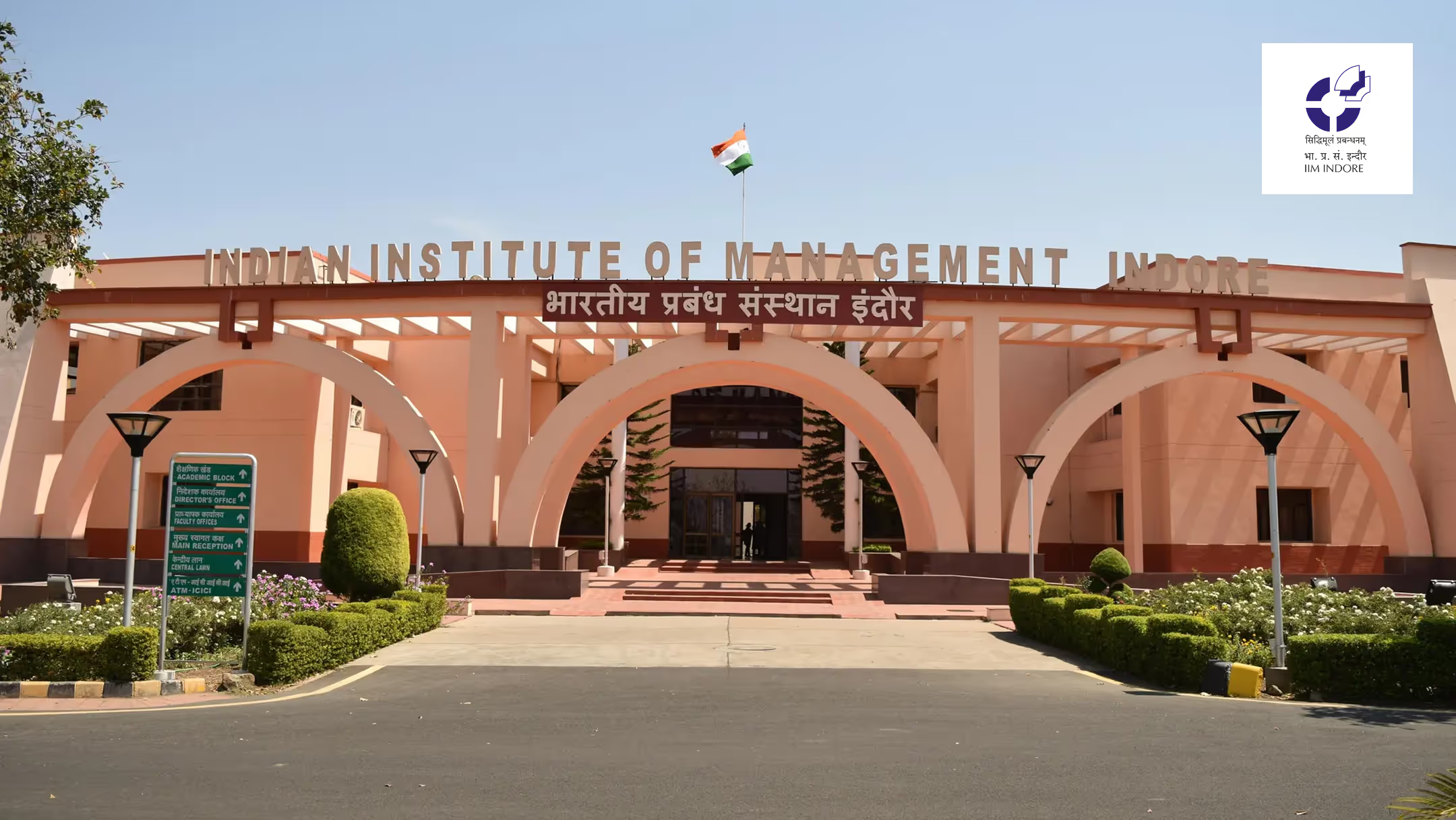
IIM Indore
Elective bidding at IIM Indore
IIM Indore adopted Registro CBS in 2017 — making it one of India's earliest premier management institutions to digitise elective course bidding. With 3,000+ students across PGP and IPM programmes, it is also among the largest implementations in the series. Manual effort is down 95%, student queries down 99%, and satisfaction has held above 4.5/5 consistently across 8 years of operation.
A defining feature of the IIM Indore implementation is dual-level credit tracking — Registro enforces elective credits at both the term level and the academic year level simultaneously, across two distinct programmes with different credit structures. The platform also manages multi-programme bidding rounds and gives the PGP office a single view across 3,000+ students and 500 electives every bidding cycle.
Scale and complexity from day one
Course bidding at IIM Indore spans two distinct programmes — PGP and IPM — each with its own credit policies, elective requirements, and student cohort size. Enforcing these policies manually across both programmes simultaneously — while tracking credits at both term and yearly level — created a coordination challenge that scaled poorly as student intake grew.
EDTEX worked closely with the PGP Programme Office to design the process, establish best practices, and configure Registro to handle IIM Indore's specific multi-programme requirements — a collaboration that has sustained over 8 years of continuous operation.
Where the process was straining
- No unified platform for multi-programme bidding across PGP and IPM simultaneously
- Credit policies enforced manually — prone to errors across two programmes with different structures
- No mechanism to track and enforce elective credits at both term and academic year level
- Multiple bidding rounds across programmes unmanageable without automation
- High volume of student queries during every registration cycle
- Resource utilisation limited — no data-driven basis for planning against growing intake
How Registro CBS met the complexity
EDTEX deployed Registro CBS at IIM Indore — configured to handle the institution's full multi-programme complexity, including the dual-level credit tracking requirement unique to IIM Indore's academic structure.
Multi-programme bidding
PGP and IPM programmes managed simultaneously — each with its own credit policies, cohort, and bidding rounds on one platform.
Dual-level credit tracking
Elective credits tracked and enforced at both term level and academic year level simultaneously — across both programmes.
Programme-specific credit enforcement
MBA and IPM programme credit requirements automatically enforced across all bidding rounds — no manual policy checking needed.
Multi-round bidding support
Multiple elective bidding rounds across both programmes — all managed within one unified platform.
Scale-ready architecture
Platform handles 3,000+ students and 500 electives per cycle — adapting seamlessly as intake has grown since 2017.
End-to-end onboarding support
Power guides, live workshops, policy consultation, live chat during active bidding, and data preparation assistance every cycle.
8 years of results
- 95% reduction in manual effort for programme offices and students since 2017
- 99% reduction in student queries during course registration
- 3,000+ students and 500 electives managed cumulatively across PGP and IPM
- Dual-level credit tracking — term and academic year — enforced automatically across both programmes
- Multi-programme bidding rounds delivered consistently across 8 years of operation
- Student satisfaction consistently rated above 4.5 out of 5.0
- Enhanced resource utilisation enabling data-driven planning for growing student intake

IIM Calcutta
Timetabling at IIM Calcutta
IIM Calcutta implemented Registro's automated timetable scheduling system to replace a manual process that had become unsustainable as course offerings and faculty numbers grew. The system — built around demand estimation data, a course clash matrix, and faculty preferences — cut scheduling time by 70%, resolved 95% of potential conflicts, and incorporated 85% of faculty preferences into the final timetable.
Before automation, the scheduling team manually assigned courses to time slots — trying to balance student demand, course clash avoidance, classroom availability, and faculty preferences simultaneously. As complexity grew, the process produced inefficiencies, conflicts, and a growing dissatisfaction among students who could not enrol in preferred courses due to poor time slot allocation.
What the manual process couldn't sustain
Manual timetabling at IIM Calcutta required constant back-and-forth between faculty, administration, and students — trying to juggle demand predictions, conflict avoidance, and faculty scheduling constraints without any unified system. As the number of courses and faculty increased, this approach produced a compounding set of failures: scheduling conflicts, under-utilised classrooms, and student dissatisfaction from poor slot allocation.
The primary goals of the automation initiative were clear: increase scheduling efficiency, match course placement to actual student demand, prevent clashes and double bookings, incorporate faculty preferences without manual negotiation, and allow quick adjustments when enrolments or availability changed mid-term.
Where every term fell short
- Weeks spent manually assigning courses to time slots — without data on actual student demand
- No clash matrix in use — course conflicts discovered only after schedules were published
- Faculty preferences collected manually — inconsistently applied and frequently overridden
- Popular courses assigned to undersized rooms — mismatched to actual enrolment demand
- Classroom utilisation unoptimised — some rooms overbooked, others consistently empty
- No mechanism for rapid re-scheduling when enrolments or faculty availability changed
- Growing student dissatisfaction from preventable timetable conflicts
How Registro built the schedule
Registro's timetabling system was built around three core data sources — demand estimation, clash matrix, and faculty preferences — with a constraint-based optimisation engine coordinating all three into a conflict-minimised output schedule.
Demand estimation model
Historical enrolment data fed into a demand model — predicting course sizes and assigning popular courses to appropriately sized venues at high-availability time slots.
Course clash matrix
A matrix of common course pairings identifies potential conflicts — ensuring courses frequently taken together are never scheduled simultaneously.
Faculty preference integration
Faculty submit preferred teaching windows and constraints. The system accommodates as many as possible while maintaining a balanced, efficient schedule.
Constraint-based optimisation engine
Balances clash minimisation, classroom matching, faculty preferences, and time slot distribution — generating the most efficient timetable from competing constraints.
Dynamic re-scheduling
Quick adjustments in response to changes in student enrolment or faculty availability — without starting the scheduling process from scratch.
Optimised classroom assignment
Courses matched to rooms based on demand predictions — eliminating the mismatch between class size and room capacity that plagued manual scheduling.
Lessons learned
Data quality was the primary implementation challenge — accurate demand estimation and up-to-date faculty preferences were essential. Initial inconsistencies required cleaning and verification before the system could perform optimally. Faculty buy-in also required clear communication; once the system demonstrated it could accommodate most preferences, skepticism resolved quickly.
What the numbers showed
- 70% reduction in time spent creating timetables — weeks of manual effort reduced to days
- 95% of potential scheduling conflicts resolved automatically by the clash matrix system
- 85% of faculty preferences successfully incorporated into the final published schedule
- Classrooms matched to courses by demand — larger enrolments assigned to appropriately sized venues
- Dynamic re-scheduling enabled quick response to enrolment changes without full restarts
- Marked reduction in student complaints about course clashes and poor time slot allocation
- Faculty satisfaction improved — instructors received preferred teaching windows at higher rates

IIM Bangalore
Academic ops at IIM Bangalore
IIM Bangalore deployed two EDTEX products simultaneously — Registro CBS for multi-programme course bidding and Registro TMS for data-driven timetable management. Together, they automated the full academic operations cycle: from elective selection across degree and exchange programmes through to instant clash-free timetable generation with direct Outlook calendar integration for faculty.
The adoption marks a significant milestone in IIMB's digital transformation — substantially reducing manual effort for both Programme Offices and students, enhancing resource utilisation, and setting a benchmark for how technology can streamline complex academic administration at scale.
Two problems, one platform
Course bidding at IIMB is among the most complex in India — involving hundreds of students across multiple degree programmes, plus international students participating in exchange programmes. Managing bid volumes, cross-programme seat allocation, and fair outcomes manually was both time-consuming and error-prone.
Timetabling added a second layer of complexity: generating schedules that honoured faculty preferences, responded to course demand, avoided clashes for students, and aligned with faculty Outlook calendars — all simultaneously — was beyond the reach of any manual process. IIMB needed both problems solved together, not independently.
Where coordination was breaking
- High-volume multi-programme bidding — degree and exchange students — managed without a unified system
- Intricate cross-programme scenarios involving seat sharing and diverse student cohort needs
- Timetable generation requiring simultaneous balancing of demand, faculty preferences, and clash avoidance
- Faculty scheduling preferences collected and applied manually — inconsistently and slowly
- No integration between timetable system and faculty Outlook calendars — conflicts discovered after publication
- Significant manual effort for both Programme Offices and students across every bidding and scheduling cycle
How CBS + TMS solved both
EDTEX deployed Registro CBS and Registro TMS together at IIMB — each solving a distinct problem, both sharing a unified data layer that made the full academic operations cycle seamless.
Multi-programme course bidding
Handles complex bidding across multiple degree programmes and exchange students — managing high bid volumes fairly and efficiently.
Cross-programme seat allocation
Intricate seat sharing and allocation scenarios across diverse student cohorts managed within one platform.
Demand-driven timetable generation
Faculty preferences and student course demand fed into the system — clash-free timetables generated instantaneously.
Outlook calendar integration
Teaching slots automatically blocked in faculty Outlook calendars — eliminating scheduling conflicts without any manual coordination.
Customised for IIMB's process
TMS configured to fit IIMB's specific scheduling requirements — both teaching and learning schedules optimised for maximum efficiency.
Exceptional EDTEX support
Prompt, efficient support during course bidding rounds and timetable scheduling — cited as pivotal to the smooth operation of both processes.
What the deployment delivered
- Multi-programme course bidding automated across degree and international exchange programmes
- Clash-free timetables generated instantaneously — factoring in demand and faculty preferences simultaneously
- Faculty Outlook calendars auto-synced — teaching slots blocked without manual intervention
- Substantial reduction in manual effort for both Programme Offices and students
- Markedly enhanced resource utilisation across the institute
- Extreme satisfaction reported by IIMB with EDTEX support during bidding and scheduling cycles
- Benchmark set for how CBS and TMS can be deployed together to solve the full academic operations challenge
IIM Calcutta
Elective bidding at IIM Calcutta
IIM Calcutta adopted Registro CBS and TMS in 2017 — and has since delivered 21 term-level elective bidding cycles across 3,000+ students and 500 electives. Manual effort is down 95%, student queries down 99%, and satisfaction has held above 4.5/5 across 8 years of continuous operation — making this one of the longest-running implementations in the series.
Registro CBS — Course Bidding SystemRegistro TMS — Timetable Scheduling
The platform manages the full PGP elective operations cycle — from demand estimation and clash matrix generation through to clash-free timetable production, faculty preference collection, credit policy enforcement, and Add/Drop rounds — all within one unified system.
8 years, 21 cycles — built on Registro
Course bidding at IIM Calcutta involves hundreds of PGP students selecting electives across terms — with credit policies, demand estimation, and timetable constraints all needing to be balanced simultaneously. Before Registro, this was managed manually by the PGP office: a process that became increasingly unsustainable as student intake and course complexity grew. EDTEX worked closely with the PGP office to design the process, configure the system, and establish best practices that have sustained across 8 years and 21 cycles.
What manual couldn't handle
- No elective demand survey or clash matrix — popular courses clashed without detection
- Timetable generation not integrated with bidding outcomes — conflicts discovered post-allocation
- Faculty preference collection manual — inconsistently applied and slow to incorporate
- MBA programme-specific credit policies enforced manually — error-prone at scale
- Add/Drop rounds managed without automation — high administrative burden each cycle
- Demand estimation rounds not supported — no data-driven basis for timetable slot assignment
- High volume of student queries every registration cycle
How CBS + TMS covered it all
Elective demand survey & clash matrix
Automated high-demand elective identification and clash matrix generation ahead of each bidding cycle.
Demand estimation & Add/Drop rounds
Registro configured to support MBA demand estimation rounds and structured Add/Drop management.
Programme credit policy enforcement
PGP credit requirements automatically enforced across all bidding rounds and terms — no manual checking needed.
Clash-free timetable generation
Timetables generated clash-free from bidding outcomes — expanding the scope of available elective offerings for students.
Faculty preference collection
Faculty preferred lecture time slots collected and incorporated into timetable generation automatically.
End-to-end onboarding support
Power guides, live workshops, policy consultation, live chat, and data preparation assistance — every cycle since 2017.
The numbers across 21 cycles
- 21 term-level elective bidding cycles successfully delivered since 2017
- 3,000+ students and 500 electives managed cumulatively on the platform
- 95% reduction in manual effort for PGP programme offices and students
- 99% reduction in student queries during course registration
- Clash-free timetables generated from bidding data — expanding available elective scope
- Faculty preferences incorporated automatically into every timetable cycle
- Student satisfaction consistently rated above 4.5 out of 5.0

IIM Ahmedabad
Admissions at IIMA
EDTEX developed and deployed a purpose-built PGP Admissions Software for IIM Ahmedabad — automating the full admissions cycle from candidate shortlisting and personal interview scheduling through to final selection list generation. The platform also incorporated comprehensive RTI support, enhancing transparency and auditability throughout the admissions process.
The admissions office of IIMA expressed extreme satisfaction with both the software and the EDTEX team's engagement — citing efficiency, transparency, and on-time delivery as defining aspects of the collaboration. IIMA has strongly recommended EDTEX's services to other institutions seeking to streamline admissions processes.
What made it complex
The PGP admissions process at IIM Ahmedabad is one of the most scrutinised academic selection processes in India. It spans multiple stages — candidate shortlisting, personal interview scheduling across a large applicant pool, and final list generation — each requiring precision, fairness, and full auditability. Managing this manually created risk at every stage and limited the admissions office's ability to respond efficiently to queries, including RTI requests.
Where the process needed support
- Manual shortlisting of candidates — time-consuming and vulnerable to inconsistency
- Personal interview scheduling managed without a centralised automated system
- Final selection list generation requiring significant manual coordination
- Limited auditability across the admissions cycle — challenging RTI query responses
- High administrative effort across the admissions office throughout the cycle
How EDTEX automated it
EDTEX integrated and automated all critical activities of IIMA's admissions process — building a user-friendly platform that significantly reduced time and effort for the admissions office while ensuring transparency and auditability at every stage.
Automated shortlisting
Candidate shortlisting integrated and automated — eliminating manual processing and ensuring consistent application of selection criteria.
PI scheduling automation
Personal interview scheduling automated across a large applicant pool — coordinated efficiently without manual intervention.
Final selection list generation
Automated generation of the final list of selected candidates — accurate, auditable, and delivered on schedule.
RTI query support
Comprehensive support for RTI queries built into the platform — full transparency and auditability throughout the admissions cycle.
The EDTEX team demonstrated an impressive ability to grasp complex, multi-domain requirements and prioritise effectively throughout development. Their commitment to cross-validation and transparency in communications ensured accuracy and reliability at every stage. All deliverables were completed on time — including periods where the team worked overtime to meet the admissions schedule.
What the admissions office said
- Full admissions cycle automated — shortlisting, PI scheduling, and final selection
- RTI query support built in — comprehensive auditability throughout the process
- All deliverables completed on schedule, including during high-pressure admissions periods
- User-friendly design significantly reduced time and effort for the admissions office
- EDTEX team cited as highly dedicated with a strong grasp of complex, multi-area requirements
- IIMA admissions office strongly recommends EDTEX to other institutions

BITSoM Mumbai
Elective bidding at BITSoM
BITSoM Mumbai deployed Registro CBS in 2022 for its very first MBA cohort — making EDTEX a founding partner in the institution's academic operations. EDTEX worked hand-in-hand with the MBA Programme Office to design the process, establish best practices, and onboard the inaugural cohort. Since then, 7 bidding cycles have been delivered across 400+ students with satisfaction consistently above 4.5/5.
The Registro platform has markedly enhanced resource utilisation at BITSoM — enabling better planning as student intake has grown from that first cohort. Manual effort is down 95%, student queries down 99%, and the platform now handles seat sharing, concentration or specialisation implementation, and programme-specific credit policies as standard.
Building a process from scratch
BITSoM is a new-generation management school — and when it launched its MBA programme, it had no existing elective bidding process to build on. The institution needed more than just software: it needed a partner who could help design the process, establish policies, and onboard an entirely new cohort of students and staff to a system they had never used before.
EDTEX stepped in as that partner — working closely with the MBA Programme Office from the outset to shape best practices and ensure the inaugural cohort had a smooth, professional bidding experience from day one.
Starting without a foundation
- No existing elective bidding process — starting from scratch with no historical baseline
- First cohort of MBA students unfamiliar with course bidding — requiring full onboarding support
- No programme-specific credit policies in place — needed to be designed and implemented simultaneously
- MBA Programme Office staff new to elective bidding management — requiring hand-held guidance
- Seat sharing and concentration or specialisation rules needed to be configured from first principles
How Registro CBS set the standard
Process design & best practices
EDTEX worked with the MBA Programme Office to design the full elective bidding process — establishing policies and best practices before the first cycle.
First cohort onboarding
Hand-held onboarding for both students and Programme Office staff — ensuring a smooth, confident start for the inaugural MBA cohort.
Programme-specific credit policies
MBA credit requirements configured and automatically enforced from the very first bidding cycle.
Seat sharing & concentration support
Platform configured for seat sharing and MBA elective concentration or specialisation implementation from launch.
Full support suite
Power guides, live workshops, policy consultation, live chat during active bidding, and data preparation assistance every cycle.
Scalable foundation
Built to scale — the same platform now serves growing cohorts without requiring process redesign as intake increases.
7 cycles in — what's different
- 95% reduction in manual effort for the MBA Programme Office and students
- 99% reduction in student queries during course registration
- 7 elective bidding cycles successfully delivered since 2022
- 400+ students and 200 electives managed cumulatively on the platform
- Programme-specific credit policies enforced from the first cycle
- Student satisfaction consistently rated above 4.5 out of 5.0
.avif)
Goa Institute of Management (GIM)
Elective selection at GIM
Goa Institute of Management implemented an advanced Elective Course Bidding System developed by EDTEX — enabling students to browse and bid for electives across multiple concentrations on a single unified platform. The system promotes interdisciplinary learning, ensures fair allocation, and provides real-time transparency throughout the selection process.
The implementation was developed in close collaboration with the EDTEX team — tailored to meet GIM's specific requirements for multi-concentration management. The result is a more flexible, personalised, and student-centred approach to elective selection that has positioned GIM as a leader in innovative academic operations.
Concentrations without a unified system
Elective selection at GIM spans multiple concentrations — each with its own course offerings, prerequisites, and student demand. Without a unified platform, managing selection across these concentrations was complex for administrators and limiting for students — who had no structured mechanism to explore and bid for electives across different areas of specialisation.
The institution needed a system that could handle the full complexity of multi-concentration elective management, give students real-time visibility into their bids, and allocate seats fairly across all concentrations simultaneously.
Where students lost flexibility
- No unified platform for elective selection across multiple concentrations
- Students unable to bid for electives outside their primary concentration — limiting interdisciplinary learning
- Manual allocation without a transparent, fair mechanism — eroding student trust in the process
- No real-time visibility into bid status or seat availability during the selection window
- High administrative burden on faculty and staff across every selection cycle
- Limited course information available to students at the point of selection
How Registro CBS opened it up
Multi-concentration management
Students bid for electives across all concentrations on one platform — enabling personalised, interdisciplinary academic paths.
Fair allocation mechanism
Transparent allocation engine ensures equitable access across all concentrations — minimising conflicts and maximising satisfaction.
Real-time bid updates
Live bid status, course availability, and seat allocation updates throughout the selection window — enabling dynamic decision-making.
Comprehensive course information
Prerequisites, credits, and course details available within the platform — helping students make informed elective ch
What GIM gained
- Multi-concentration elective bidding live — students select across specialisations in one unified platform
- Fair allocation mechanism ensuring equitable access for all students across all concentrations
- Real-time bid status and availability updates throughout the selection process
- Significant reduction in administrative workload for faculty and programme staff
- Students able to explore interdisciplinary electives across business, policy, and specialised fields
- GIM positioned as a leader in innovative, student-centred academic operations
Support and Collaboration with EDTEX
The successful implementation of the Elective Course Bidding System at GIM was made possible through close collaboration with the EDTEX team. Their expertise in developing robust educational software solutions ensured that the system was tailored to meet the specific needs of GIM. The EDTEX team provided continuous support throughout the implementation process, addressing any issues promptly and ensuring a smooth transition to the new system.
Conclusion
The advanced Elective Course Bidding System at Goa Institute of Management marks a significant milestone in enhancing the academic experience for students. By enabling the selection of electives across multiple concentrations, GIM has provided a more flexible and personalized approach to education. The support and expertise of the EDTEX team have been instrumental in this successful implementation, positioning GIM as a leader in innovative educational solutions.
This new system not only streamlines the elective selection process but also enhances transparency, efficiency, and flexibility, ultimately contributing to a more dynamic and student-centered learning environment.

CIN: U74999TG2016PTC110546
GST: 36AABCW8421F1ZD
PAN: AABCW8421F




.png)
.png)
.png)