
Course Bidding

Transform Your Academic Operations
Automate course bidding, timetable scheduling, placements, and student exchange processes. Improve operational efficiency while enhancing the student experience.
Scale Program Offerings
Expand academic programs and courses to meet growing student demand without adding administrative overhead.
Optimize Resources
Maximize efficient use of faculty, classrooms, and administrative resources across all operations.
Eliminate Conflicts
AI-powered scheduling ensures zero timetable clashes, room conflicts, or prerequisite violations.
Improve Student Experience
Fair course allocation, transparent processes, and seamless digital touchpoints for students.
Course Bidding System
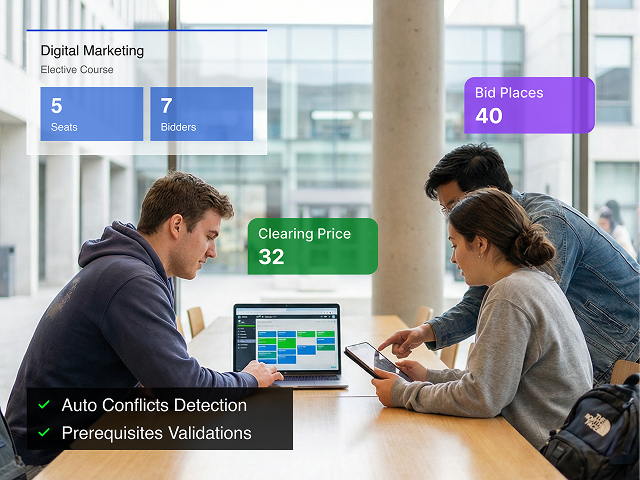
Replace chaotic first-come-first-served enrollment with a fair, transparent bidding system. Students bid on preferred courses using points — ensuring equitable access regardless of timezone.
Timetable Scheduling
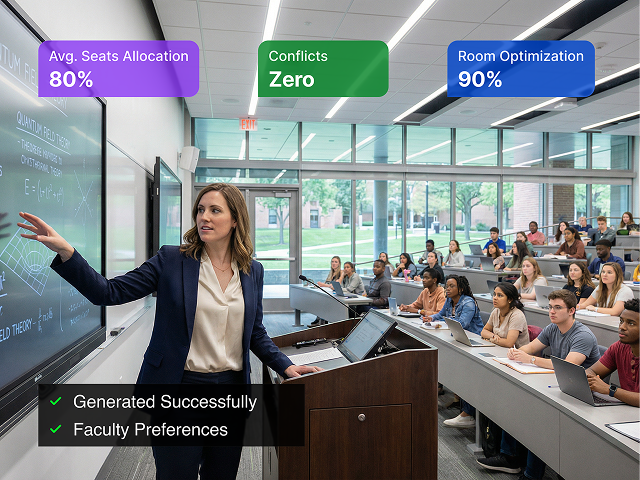
Generate conflict-free timetables in days instead of weeks. AI-powered scheduling handles faculty availability, room constraints, and student preferences automatically.
Student Exchange Management
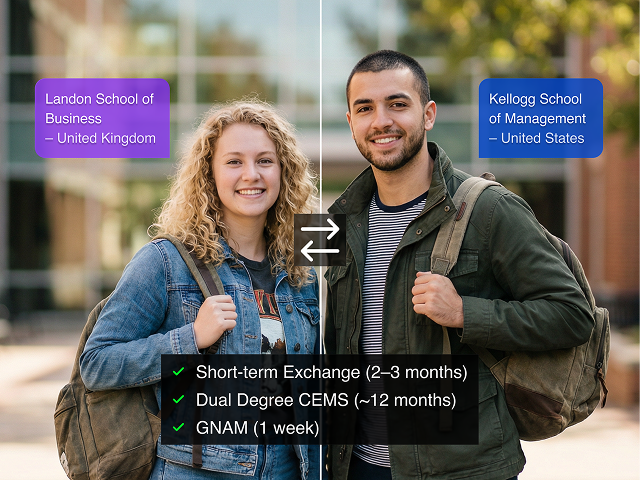
Streamline incoming and outgoing student exchange processes. Manage partner universities, student applications, credit transfers, and compliance documentation in one place.
Placement Automation
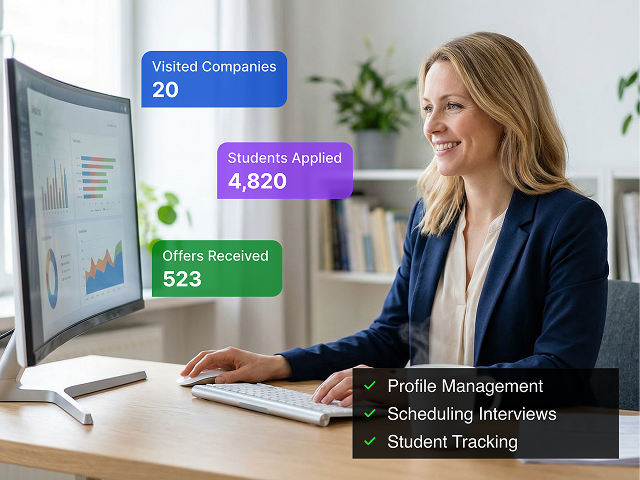
End-to-end placement operations automation — from company outreach to offer management. Reduce placement team workload by 60% while improving recruiter and student experience.
University Analytics & Insights
Data-driven decision making for academic leaders. Track student outcomes, faculty utilization, placement metrics, and operational efficiency across all processes.
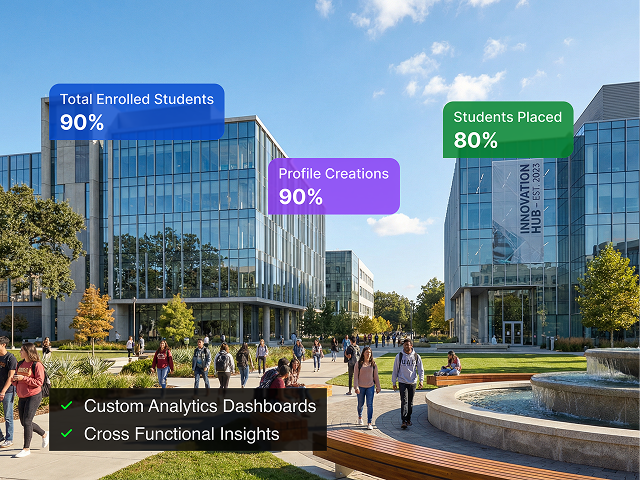
Transform Your Academic Operations
Automate course bidding, timetable scheduling, placements, and student exchange processes. Improve operational efficiency while enhancing the student experience.



















From the EDTEX Blog



Powering Outcomes in Global Institutions
Streamline processes & improved operational efficiencies.
Accessing those insights in real-time enabled me to assess my elective options and determine the optimal maximum bid points required to secure them.


The real-time insights we received were instrumental in preventing potential mistakes and significantly aided our decision-making process regarding elective courses.

Viewing the real-time data of active bidders, MRB, and rank helps me decide whether to add more bidding points or switch to a different course.

Real-time insights allowed me to quickly adjust my bidding strategy, understand competition, and make better decisions to secure my desired courses.

EDTEX - Skynet Placement Automation Product Team have rendered their services and support for the Placement Process at IIM Bangalore since March 2020. The software has been successfully implemented and rendered

I had the pleasure of using EDTEX Skynet for conducting placement operations for SIPs & final placements. Skynet is customizable, allowing us to design the platform entirely around our specific processes. The team is knowledgeable & experienced in managing placement processes for top B-schools. What truly sets them apart is their 24x7 support. Any issues we encountered were resolved promptly, even under tight deadlines. I highly recommend Skynet to any institution running placement processes.

We are happy to recommend the Course Bidding System software, which was developed by our student and alumnus Mr. Anil Kumar Vishwanadhula for IIMA.

We had an exceptional experience with the Skynet portal, developed by EdTex, during the placement process at IIM Lucknow. The platform's automation of scheduling interviews and GDs played a pivotal role in ensuring a smooth and seamless placement process. A special mention to Shrikant, Abdullah, and Anil for their unwavering support throughout the placement season. Their availability, even at odd hours like 12 AM, ensured a hassle free experience for both students and recruiters.

EDTEX did an excellent job of integrating and automating all the activities of our admissions process including shortlisting, scheduling of personnel interviews and generating the list of final selected candidates in an extremely user-friendly product.

I strongly recommend EDTEX to anyone who is looking for software solutions related to any academic and placement related activities. Their team will be there to support you always, their solutions are also fool proof.

Had a really positive experience using this portal for my colleges placement process. The team was also very helpful in resolving any issues ASAP.

IIMB is extremely satisfied with the efficient support being provided by the EDTEX team during the Course Bidding rounds and while scheduling the term Timetable.

EDTEX Skynet transformed our placement process by digitalizing workflows and making key data easily accessible. For the Placement Office, its interactive dashboards provide actionable insights, improving placement outcomes and student preparation. For students, it’s a one-stop platform for tracking progress and accessing placement data. For the Placement Committee, it simplifies data collection, job postings, applications, and communication, ensuring a seamless and efficient process.

The whole platform (Skynet - Placement Automation) is very well automated. The team was present for the entire cycle, providing robust services.

AI-Powered Academic Operations Automation

Frequently Asked Questions
Everything you need to know about EDTEX and our academic automation solutions.
Course bidding is a market-based way to allocate seats in popular electives. Each student receives a budget of bid points and bids on the courses they want; seats typically go to the highest bids up to each course's capacity. Business schools use it because bids reveal how much students value each course, not just their ranked preferences. Registro Course Bidding automates the full process.
EDTEX provides comprehensive training sessions, user manuals, video power guides, and ongoing support so administrators and students are fully equipped to use the Registro Course Bidding platform. Live support is available during active bidding windows when timely help matters most.
EDTEX trains programme office administrators to configure and run bidding rounds, and provides user manuals and guides for students. The team offers live support during bidding windows, when timing and fairness matter most.
Registro Course Bidding reports on bidding trends, student preferences, course demand, clearing bids and allocation efficiency. Programme offices use this data to decide how many sections to run, set course capacities and plan next term's electives.
Students who miss a preferred course can bid again in later rounds or enrol in alternative courses with available seats. Registro shows seat availability between rounds, so every student can complete a full schedule.
Registro Course Bidding protects student data with two-factor authentication, encryption and access controls, and supports single sign-on through Google Workspace and Microsoft Entra ID.
Yes. Registro Course Bidding integrates with major student information systems, such as Ellucian and Anthology Student, through standard APIs, keeping student, course and enrolment data in sync.
Administrators can reopen or extend the registration window for students affected by a changed or cancelled course, so they can re-bid or choose another course.
Registro processes every bid with the same rules-based algorithm, configured to your institution's bidding policy. Students see seat availability, clearing bids, prerequisite requirements and timetable clashes in real time, so allocations can be understood and verified rather than taken on trust.
Yes. Registro Course Bidding is configured to your institution's rules—whether that means specific bid-point allocations, multiple bidding rounds or real-time open bidding—and supports the full range of electives your programmes offer.
Yes. Registro runs demand estimation rounds—surveys in which students indicate interest in courses planned for future terms. Programme offices use the results to decide which electives to offer and how many sections to schedule before bidding opens.
Yes, when the institution uses Registro's real-time open bidding workflow. Students can then see their bid status, seat availability and clearing bids live as the round progresses.
Yes. Registro Timetable Automation schedules common electives taken by students from different programmes—such as MBA, undergraduate and doctoral cohorts—in a single timetable. Because every programme draws on the same pool of faculty, rooms and slots, a shared elective is placed once without clashing with any participating programme's core courses.
Registro prevents clashes by treating faculty, classrooms and time slots as institution-wide resources and scheduling every programme in a single optimisation run. A professor or room can be assigned only once per slot, so one programme's timetable can never create a clash in another's.
Multi-programme timetabling is scheduling several programmes—such as MBA, undergraduate and doctoral cohorts—that share the same faculty and rooms. Registro handles it by keeping each programme's rules, calendars and constraints separate while optimising shared resources together, so every programme gets a workable timetable without manual coordination between offices.
The Skynet Placement Automation software provides detailed reports and analytics on placement operations with focus on Master Profile Creation, Resume Variants, Placement Talk events, Applications, Offers, employer engagement, with scope for custom reports. These insights help placement offices benchmark outcomes and make informed, data-driven decisions.
Registro needs: courses and sections, faculty and their preferences, rooms and capacities, student groups, active time slots and teaching weeks, holidays, and your institution's hard and soft constraints. This data can be imported from your existing ERP or spreadsheets.
Timetable automation is software that generates an institution's class schedule automatically, using optimisation algorithms to satisfy constraints such as faculty availability, room capacity and student clashes. It replaces manual spreadsheet scheduling and lets schedulers re-run the timetable whenever something changes. Registro Timetable Automation is EDTEX's platform for business schools and universities.
Automated timetabling with Registro removes manual clashes, cuts the time schedulers spend building and revising timetables, and ensures every hard constraint—room capacity, faculty availability, student conflicts—is met. When faculty or rooms change mid-term, the timetable can be regenerated instead of rebuilt by hand.
Registro provides reports and analytics on each generated timetable, including room utilisation and how conflicts were resolved. Programme offices use them to spot under-used rooms and explain scheduling decisions to faculty and leadership.
Registro secures timetable data with two-factor authentication, single sign-on through Google Workspace or Microsoft Entra ID, encryption and access controls, so only authorised staff can view or change schedules. The same security model applies across all EDTEX products.
Deploying Registro Timetable Automation typically takes a few weeks, depending on the number of programmes, the complexity of your constraints and how ready your data is. Most of that time goes into configuring the system to your academic policies and validating a first timetable with your programme office.
Registro treats hard constraints—room capacity, faculty availability, no student clashes—as rules every timetable must satisfy, and soft constraints—such as preferred time slots—as preferences to meet wherever possible. The optimiser first guarantees every hard constraint, then satisfies as many soft constraints as it can.
Yes. Registro uses machine learning on past schedules and user feedback to improve future timetables, so each scheduling cycle needs fewer manual adjustments than the last.
Yes. Registro treats each campus as a distinct entity with its own rooms, calendars and constraints, so each campus's resources and rules are respected in the final timetable.
Registro combines genetic algorithms, backtracking, simulated annealing and local search. Timetabling is a combinatorially hard (NP-hard) problem, and using several methods together lets Registro find clash-free, efficient timetables at the scale of a full business school or university, where any single technique struggles.
Registro detects and resolves conflicts automatically during scheduling. Any conflict it cannot resolve is flagged with the reason, and built-in rescheduling utilities let staff fix it manually without rebuilding the timetable.
Yes. Registro integrates with university ERPs and student information systems, including Oracle, SAP, Ellucian and Anthology Student, through APIs and data import/export. Course, faculty and student data flow in and the published timetable flows back, so there is one version of the schedule across systems.
Yes. Students view their personal timetables in the Registro student portal, which updates in real time when a class is moved, cancelled or rescheduled.
Course bidding is a market-based way to allocate seats in popular electives. Each student receives a budget of bid points and bids on the courses they want; seats typically go to the highest bids up to each course's capacity. Business schools use it because bids reveal how much students value each course, not just their ranked preferences. Registro Course Bidding automates the full process.
EDTEX provides comprehensive training sessions, user manuals, video power guides, and ongoing support so administrators and students are fully equipped to use the Registro Course Bidding platform. Live support is available during active bidding windows when timely help matters most.
EDTEX trains programme office administrators to configure and run bidding rounds, and provides user manuals and guides for students. The team offers live support during bidding windows, when timing and fairness matter most.
Registro Course Bidding reports on bidding trends, student preferences, course demand, clearing bids and allocation efficiency. Programme offices use this data to decide how many sections to run, set course capacities and plan next term's electives.
Students who miss a preferred course can bid again in later rounds or enrol in alternative courses with available seats. Registro shows seat availability between rounds, so every student can complete a full schedule.
Registro Course Bidding protects student data with two-factor authentication, encryption and access controls, and supports single sign-on through Google Workspace and Microsoft Entra ID.
Yes. Registro Course Bidding integrates with major student information systems, such as Ellucian and Anthology Student, through standard APIs, keeping student, course and enrolment data in sync.
Administrators can reopen or extend the registration window for students affected by a changed or cancelled course, so they can re-bid or choose another course.
Registro processes every bid with the same rules-based algorithm, configured to your institution's bidding policy. Students see seat availability, clearing bids, prerequisite requirements and timetable clashes in real time, so allocations can be understood and verified rather than taken on trust.
Yes. Registro Course Bidding is configured to your institution's rules—whether that means specific bid-point allocations, multiple bidding rounds or real-time open bidding—and supports the full range of electives your programmes offer.
Yes. Registro runs demand estimation rounds—surveys in which students indicate interest in courses planned for future terms. Programme offices use the results to decide which electives to offer and how many sections to schedule before bidding opens.
Yes, when the institution uses Registro's real-time open bidding workflow. Students can then see their bid status, seat availability and clearing bids live as the round progresses.
EDTEX trains placement office, career services and placement committee teams to run Skynet, and provides video power guides and user manuals for students. The team also offers live support on critical placement days, when delays directly affect students and recruiters.
Yes. Skynet integrates with student information and career management systems, including Salesforce Education Cloud, through standard APIs. Student profiles, eligibility and placement outcomes stay in sync, so the placement committee works from the same data as the programme office.
The Skynet Placement Automation software provides detailed reports and analytics on placement statistics, employer engagement, and student performance, with the scope fo custom reports, helping administrators make informed decisions.
The Skynet placement automation software uses transparent algorithms to process applications and interview schedules based on Student Preferences towards companies, Student Interview load on Days 0 and 1, Company preferences towards shortlisted students, and Interview starting times, ensuring fairness and equal interview opportunities for all students.
Skynet lets the placement committee change or cancel a recruiter's process at the job level at short notice, and automatically notifies every affected student, so no one is left waiting for updates.
Students log in to Skynet with their institutional credentials, browse job postings, and apply within the rules set by their placement office. Eligibility is checked automatically against each role's criteria.
Students track every application in Skynet in real time, including application status, interview schedules and job offers.
Yes, as an optional feature. When the institution enables it, recruiters and the placement committee can share feedback on applications and interviews with students in Skynet.
Skynet supports final placements, summer internships, lateral placements, rolling placements, short-term virtual industry projects and industry co-op programmes. Each process can be configured with its own eligibility rules, calendar and policies.
Yes. Skynet automates scheduling of interviews and group discussions, and tracks student and interview status in real time on high-intensity days such as Day 0 and Day 1. Placement committees see who is where and which rounds are running without juggling spreadsheets.
Registro Academic ERP users can use FAQs, user guides and a help desk for technical support. During registration and other critical windows, EDTEX provides live support so issues are resolved while students are still in the process.
Registro Academic ERP reports on student performance, enrolment trends and resource utilisation, and supports custom reports defined by your programme office.
Registro Academic ERP is implemented in stages: needs assessment, configuration to your academic policies, integration with existing systems, testing and user training before go-live. Scope is agreed with your programme offices up front, so the system reflects how your institution already runs.
The Registro Academic ERP - Student Information System includes a Query Management System messaging and communication features that facilitate easy interaction with Programme office advisors, enabling you to seek guidance and support.
Registro Academic ERP protects student data with two-factor authentication, single sign-on through Google Workspace and Microsoft Entra ID, encryption and access controls, and is designed to support compliance with GDPR and India's DPDP Act.
Registro links curriculum planning to real demand: course scheduling, course bidding, timetable generation and faculty assignment all work from the same data, so programme offices allocate sections, faculty and rooms based on what students actually choose.
Yes. Registro Academic ERP can be updated to reflect changes in academic policies and procedures, so the system keeps pace with your institution rather than forcing workarounds.
Yes. Registro Academic ERP manages diverse programmes—such as MBA, executive, doctoral and undergraduate—each with its own requirements, within the functional scope agreed with your programme offices.
Yes. Students use Registro to view grades, track academic performance and check progress against their degree requirements.
Students log in to Registro to register for courses, view their schedules, check grades and monitor academic progress from one portal.
Registro EPAS gives students their institution's pre-departure checklists, cultural orientation material and key contacts in one place, kept up to date by the international relations office.
The Registro EPAS - Student Exchange Automation platform provides detailed reports and analytics on student participation, partner university performance, application trends, and program success metrics to support informed decision-making.
Registro EPAS gives international relations teams data on every exchange partner—programme factsheets, participation and application trends—so decisions about which partnerships to grow, renew or retire are based on evidence.
Registro EPAS protects student personal data with encryption and access controls and is designed to support compliance with GDPR and other applicable data protection regulations—important when student records move between institutions in different countries.
Registro EPAS records the information needed to manage credit transfer and course equivalencies, so students receive the right recognition for courses completed at a partner institution.
Registro EPAS includes partner university factsheets that let students and staff compare partners on academic quality, programme compatibility and student feedback.
Once the application window opens, students log in to Registro EPAS with their institutional credentials, browse available exchange programmes and partner factsheets, and submit their preferences.
Yes. Students track their application in Registro EPAS from submission through seat allocation and acceptance, including any additional steps they need to complete.
Yes. Registro EPAS can be updated as academic policies and partner exchange agreements change, so seat allocations and eligibility always reflect current agreements.
Registro EPAS manages semester exchanges, summer programmes and dual-degree programmes, each with its own requirements.
See it in Action. We can Help.
CIN: U74999TG2016PTC110546
GST: 36AABCW8421F1ZD
PAN: AABCW8421F




.png)
.png)
.png)